
How to Calculate Container Capacity for a Building Renovation
Published · Guide by WTR Services
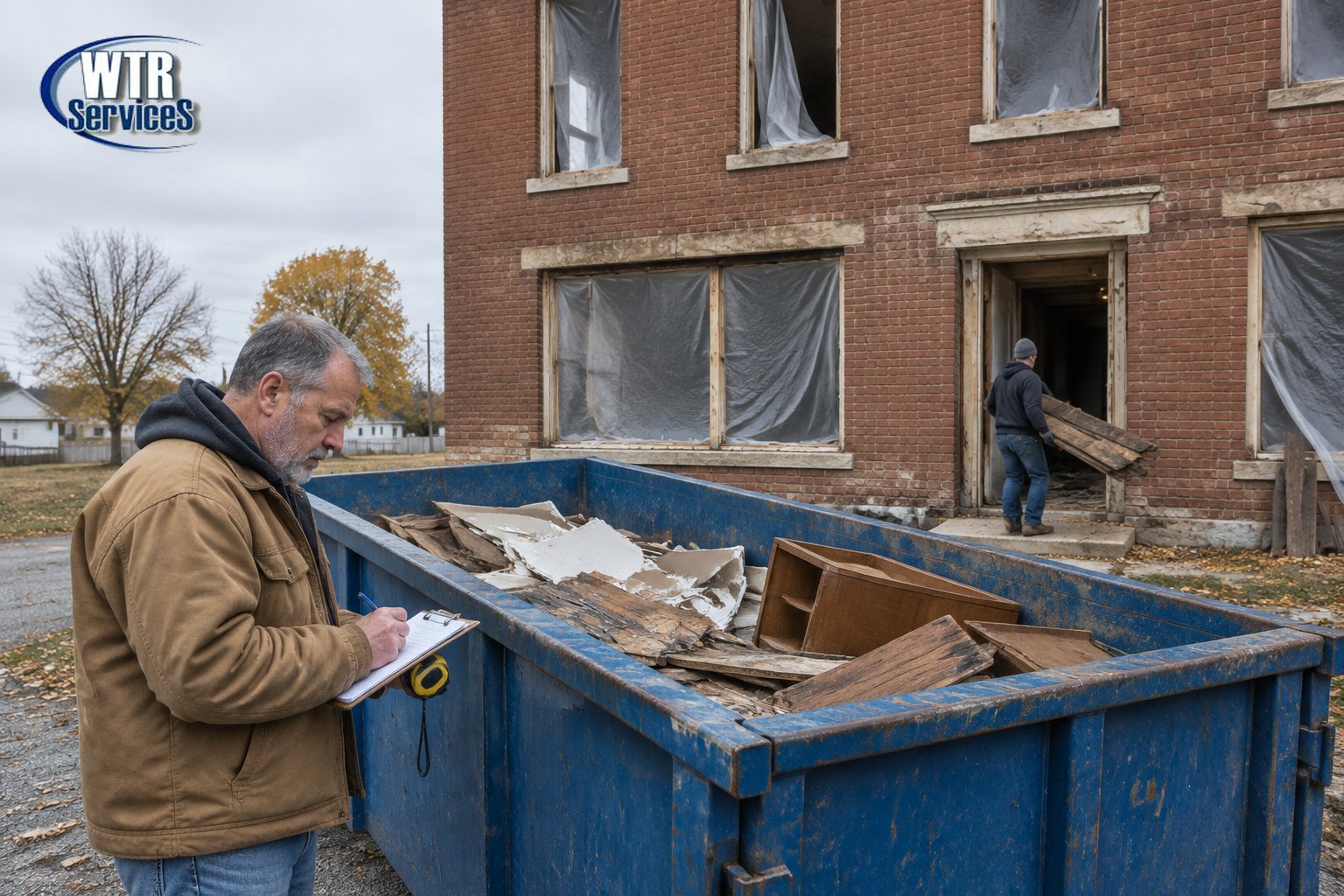
Planning a building renovation involves more than choosing materials and setting a work schedule. You also need to know how much container space the project will take. Old flooring, drywall, lumber, tile, brick and broken fixtures can fill a dumpster quickly, especially when several rooms or floors are being worked on.
A clear renovation debris volume calculation helps you book the right container capacity before work starts. It cuts the risk of ordering a container that is too small, or paying for far more space than you need.
This guide is for whole-building jobs, such as a full house, an upstairs and downstairs remodel, a rental property or a small storefront. If you only need to measure one room’s materials, the renovation waste estimating guide goes material by material, and if the debris is already piled up, the project debris estimating guide shows how to measure piles. Here, we put those numbers together for the whole building and turn them into a container size and a number of hauls.
What Waste Will Each Area of the Building Produce?
How Do You Measure Each Work Area?
| What you are removing | What to measure | Formula for cubic feet |
|---|---|---|
| Flooring | Floor length, width and total thickness of the layers | Length × width × thickness |
| Wall sections | Wall length, height and thickness | Length × height × thickness |
| Solid material such as a slab or brick | Length, width and thickness | Length × width × thickness |
| Box-shaped debris such as cabinets or stacked piles | Length, width and height | Length × width × height |
How Do You Turn Measurements Into Cubic Yards?
How Much Extra Space Should You Allow?
- Irregular shapes: Broken lumber and fixtures don’t stack neatly.
- Bulky items: Cabinets, vanities and tubs need open space around them.
- Mixed materials: Different waste types leave empty pockets between them.
- Breaking and handling: Some materials spread out once they are torn out.
How Do You Build a Whole-Building Worksheet?
| Material | Estimated volume |
|---|---|
| Old flooring | 3 cubic yards |
| Drywall partition | 2 cubic yards |
| Wood cabinets | 4 cubic yards |
| Total estimated volume | 9 cubic yards |
| Area | Main debris | Estimated volume |
|---|---|---|
| Ground-floor kitchen | Cabinets, countertops, drywall | 6 cubic yards |
| Ground-floor bathroom | Tile, tub, vanity | 2.5 cubic yards |
| Ground-floor flooring | Old hardwood and underlayment | 3.5 cubic yards |
| Upstairs bedrooms | Drywall and carpet | 8 cubic yards |
| Upstairs bathroom | Tile, toilet, vanity | 2.5 cubic yards |
| Packaging and trim | Boxes, baseboards, door frames | 3.5 cubic yards |
| Total estimated volume | All areas | 26 cubic yards |
How Do You Match the Estimate to Container Capacity?
| Container size | Nominal capacity |
|---|---|
| 10-yard | 270 cu ft |
| 15-yard | 405 cu ft |
| 20-yard | 540 cu ft |
| 30-yard | 810 cu ft |
| 40-yard | 1,080 cu ft |
- Usable capacity: Debris has to stay level with the top edge, so plan on the space below it.
- Accepted materials: Confirm which kinds of renovation waste can go in.
- Weight allowance: Concrete, brick and tile can reach the weight allowance before the container looks full.
- Placement space: Make sure the delivery area fits the container you choose.
Should You Use One Large Container or Several Hauls?
- You have plenty of room for it to sit on site.
- Most of the debris comes out in one big strip-out.
- The waste is mostly light and bulky, such as drywall, carpet and cabinets.
- Space on the driveway or lot is tight.
- The work moves floor by floor or unit by unit.
- Heavy debris like tile or brick would push a large container past its weight allowance.
What Collection and Disposal Rules Should You Check?
- Confirm which materials the provider accepts.
- Ask whether heavy debris has separate weight rules.
- Check whether any materials need separate disposal.
- Plan delivery around your renovation schedule.
- Keep the loading area clear for pickup.
Plan Your Renovation Waste Removal With Confidence
Key Takeaways
- List every material you will remove, area by area, before choosing a size.
- Measure each part of the building separately, in feet.
- Multiply length × width × height or thickness, then divide by 27 for cubic yards.
- Add about 10 to 20 percent for bulky and irregular debris.
- If your total lands right at a container’s capacity, go up a size or plan an extra haul.
- Check the weight allowance as well as the volume.
- Confirm accepted materials before you book.
Frequently Asked Questions
Keep Reading: Related Guides
- Managing Building Debris on Large Construction Sites: A Contractor's Guide
Manage debris on large, multi-crew construction sites: set up sorted collection zones, run more than one container, time pickups to each phase and assign who checks fill levels.
- How to Plan Waste Disposal for a Small Construction Project
Plan waste disposal for a small construction project: list the debris each stage creates, sort it from day one, compare dumpster, hauling and self-haul, and time delivery.
- Choosing the Right Waste Container for a Multi-Room Home Remodel
Plan dumpster rental for a multi-room remodel: see what each room throws out, split disposal into strip-out, build and finishing phases, and match container size and weight.
- What Size Roll-Off Container Works Best for a Garage or Basement Cleanout?
Compare 10, 15, 20 and 30-yard roll-off containers for garage and basement cleanouts: count furniture, boxes and appliances, then match your junk to a size.