
All Articles

How to Estimate Project Debris Before Renting a Dumpster

Published · Guide by WTR Services
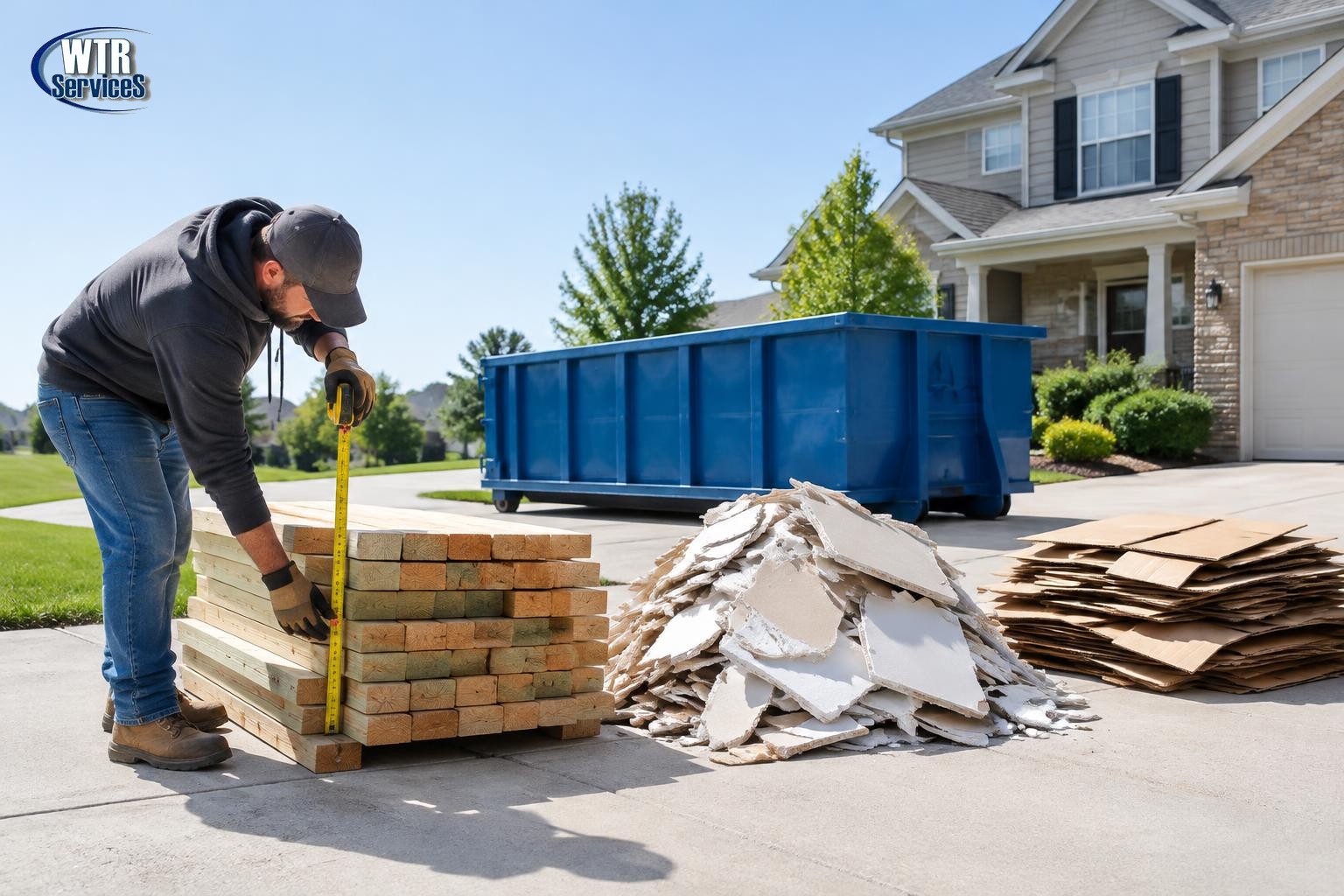
Contractor measuring a lumber pile beside separate drywall and cardboard debris, with a blue roll-off dumpster behind and WTR Services logo in the upper-left

A good dumpster rental estimate starts with the debris your project will produce, not the size of the room you’re working on. Measure your waste piles, work out the volume in cubic yards, and think about how heavy the material is before you pick a container. With guidance from WTR Services, you can compare dumpster sizing options with confidence, avoid running out of space, and anticipate potential weight-related charges before booking.

What Materials Will Your Project Produce?

Start by writing down everything you expect to haul away. A kitchen renovation might give you old cabinets, drywall, flooring, cardboard packaging, and lumber scraps. A roofing job usually means shingles, underlayment, and some damaged wood. The U.S. Environmental Protection Agency’s construction and demolition debris data lists wood, drywall, brick, concrete, and asphalt shingles among the most common parts of construction and demolition waste. Once you have your list, split it into two groups:
  • Bulky, lighter debris: cardboard, packaging, insulation, and some wood scraps.
  • Dense, heavy debris: concrete, brick, tile, soil, and roofing shingles.
The split matters because a container can have plenty of room left and still go over its weight allowance. Use the EPA construction and demolition overview for background. For dense debris, review concrete, brick and asphalt disposal before assuming it can share a general load.

How Do You Calculate Debris Volume?

For a pile that’s roughly rectangular, the formula is simple: Length (ft) × width (ft) × height (ft) ÷ 27 = cubic yards Take every measurement in feet. One cubic yard is 27 cubic feet. Irregular piles take a little more care. Use the smallest reasonable length, width, and average height that still contain the material. If the shape is really uneven, break the pile into smaller sections, calculate each one, and add them up. Try not to guess from floor area alone. A 100-square-foot room won’t produce a set amount of debris. What you end up with depends on what’s coming out and how much of it you’re throwing away. Measure safely from outside the pile. Do not climb unstable debris or enter a dumpster to take measurements. Use an average height and treat the result as an estimate rather than an exact packed-container measurement.

How Can You Build a Dumpster Rental Estimate?

Here’s a hypothetical renovation with four measured debris piles:
MaterialMeasurements (L × W × H)Approx. volume
Drywall scraps4 × 4 × 2 ft1.19 yd³
Lumber scraps5 × 3 × 2 ft1.11 yd³
Flooring waste4 × 3 × 1 ft0.44 yd³
Packaging4 × 3 × 2 ft0.89 yd³
Total measured debris3.63 yd³
That total comes to about 98 cubic feet. Add a 10% cushion for the unknowns and you land at roughly 4 cubic yards. Keep in mind this only covers the four piles listed. It isn’t a prediction for every bedroom addition or renovation. If demolition hasn’t started yet, walls, flooring, and fixtures may turn up more waste once they come out. On volume alone, a nominal 10-yard dumpster has room for these piles. That doesn’t mean it’s the right container for the whole project. Before you decide, add any demolition debris that isn’t in your measurements, then check the weight of what you’re throwing away against the container’s weight allowance. The unrounded calculation is 98 ÷ 27 = 3.6296 cubic yards. A 10% example buffer gives 3.9926 cubic yards, or about 4 cubic yards. Rounded row values can differ slightly from the total; calculate the total from the original measurements.

How Do You Estimate Dumpster Size Before Booking?

Start with nominal capacity, then narrow the choice using weight and your project’s scope. The table below compares volume only. It doesn’t show container dimensions or included weight allowances, and those can differ by rental.
Nominal sizeCapacity in cubic feetCommon project examples
10-yard270 cu ftSmall cleanouts and minor remodeling
15-yard405 cu ftGarage cleanouts and smaller deck projects
20-yard540 cu ftKitchen renovations and flooring removal
30-yard810 cu ftLarger renovations and substantial demolition
40-yard1,080 cu ftHigh-volume construction and commercial cleanup
Before you book, confirm the exact dimensions and included weight allowance for the container you’re considering. If you want more detail, you can compare dumpster sizes, residential dumpster sizes, and commercial dumpster sizes. Here’s a handy rule of thumb: if your estimate lands within about 10% of a container’s nominal capacity, think about going up a size. It’s a cushion for uncertainty, not an industry standard. Make sure the extra space fits your debris type and your budget. After calculating your debris—not before—use the dumpster sizing guide, five-size comparison, and commercial dumpster sizes to discuss options. For household projects, see residential dumpster rental.

Why Do Material Weight and Dumpster Capacity Both Matter?

Volume tells you how much space your debris takes up. Weight tells you whether the load stays inside the container’s included allowance and any transport limits. Concrete, brick, soil, and tile get heavy fast, often before the container even looks full. Shingles add a lot of weight too, depending on the roofing type and how many layers you’re tearing off. Wet drywall, wood, and other absorbent debris can weigh more than you’d expect. There’s no single weight-per-cubic-yard number that works for every material. Density shifts with the makeup of the debris, how much moisture it holds, and how tightly it’s broken up or packed. If your project includes dense material, tell the rental provider what you’re removing and ask whether it needs its own container or special handling. The rental terms say that weight above the included allowance may bring an overage charge. They also ask customers not to fill the container above its top edge. Confirm the current allowance and overage rate for your specific rental. Review dumpster weight limits and prohibited materials, then confirm the limits for your specific load. Never treat a cubic-yard estimate as a guaranteed tonnage allowance.

Common Dumpster Estimating Mistakes

Three mistakes tend to throw off an estimate:
  • Forgetting packaging: Boxes, protective wrap, and leftover delivery materials add up in volume.
  • Ignoring heavy debris: Concrete, tile, and shingles can hit the weight limit before the container is full.
  • Measuring too early: A tidy pile of visible scraps won’t show the extra waste that demolition creates.
Revisit your estimate whenever the scope changes. Taking out a wall or adding a roof tear-off can change both the volume and the weight of the load. For uncertain scope, compare the small-versus-large dumpster planning guide. For an expansion of an occupied home, follow the home-addition debris plan.

What Should You Tell Your Provider Before Booking?

A hauler can recommend the right size much more easily when you give them the same details they’d use to judge a load. Have these ready when you call or ask for a quote:
  • Project type and scope: Which rooms, structures, or surfaces are being cleared.
  • Material list: Drywall, wood, shingles, concrete, appliances, and anything else going in.
  • Your volume estimate: The pile measurements and the total cubic yards you worked out.
  • Heavy materials: Any concrete, brick, tile, or soil, since these add more weight than bulk.
  • Placement details: Where the container will sit, how much driveway or curb space you have, whether trucks can reach it, any low wires or branches overhead, and whether your area requires a permit.
  • Timeline: How long the work will run and the date you need the container dropped off.
Once the provider has this, they can recommend a size from what you’re actually throwing away and how heavy it is, not just from the type of project. Check delivery preparation and Ohio placement and permit guidance. Once the dumpster arrives, follow safe roll-off loading practices. Send WTR Services your project details or call (330) 399-3817 with your material list, measurements, location and timeline.

Frequently Asked Questions

Keep Reading: Related Guides